News & Events
ITB and KZNEDT Forge Partnership to Transform Rural Education
The Ingonyama Trust Board (ITB) has renewed its commitment to rural development through a powerful new partnership with the KwaZulu-Natal Educational Development Trust (KZNEDT), aimed at empowering teachers, learners, and communities across the province’s traditional areas.
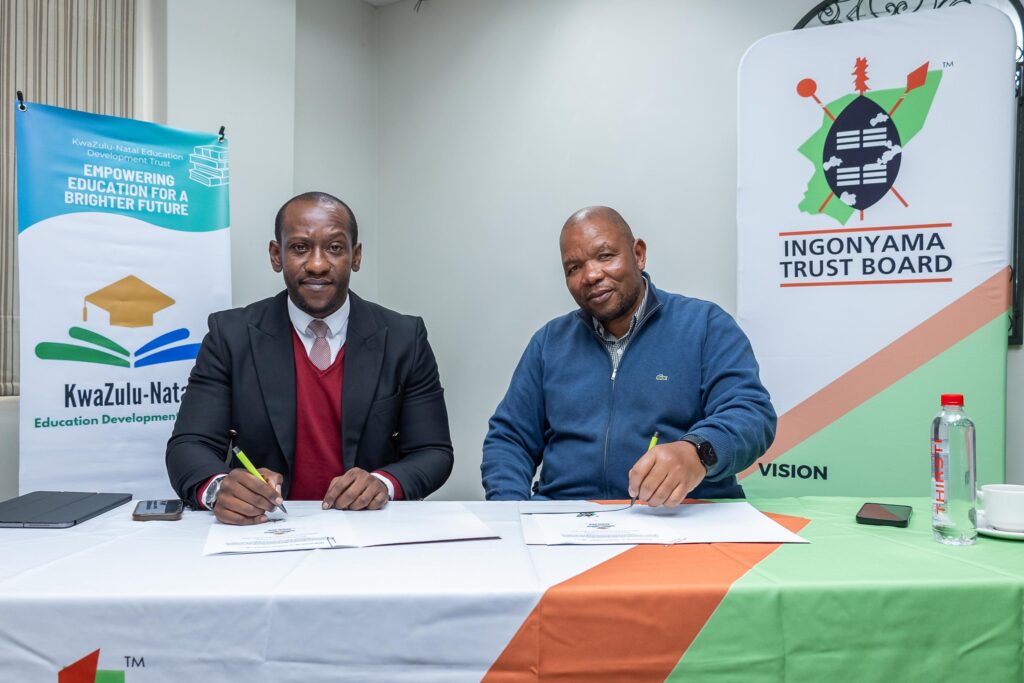
The collaboration was formalised at a signing ceremony held in Pietermaritzburg, where both entities signed a Memorandum of Understanding (MoU) to address some of the most pressing challenges affecting education in rural KwaZulu-Natal.
The KZN Education Development Trust will play a central role in mobilising resources to improve school infrastructure, support teacher development, and enhance learning outcomes for rural pupils.
“For us, this is historic,” said Advocate Linda Zama, Deputy Chairperson of the Ingonyama Trust Board. “It hasn’t happened before with either the Ingonyama Trust or the KZN Education Development Trust. We are partnering to support the KZN Department of Education and make life for learners and teachers in rural areas more bearable by improving sanitation, teaching quality, and connectivity, so that children can enjoy modern education. We look forward to achieving tangible results over the next three years.”
The partnership aligns directly with the Ingonyama Trust’s mandate to administer land for the material welfare and social well-being of traditional communities. By investing in education, ITB aims to build self-reliant, thriving communities that can harness the full potential of their land and local resources.
Mr Siyamdumisa Vilakazi, Acting Chief Executive Officer of the Ingonyama Trust Board, reaffirmed this vision.
“For Ingonyama Trust land to truly empower our people, we must invest in their knowledge and skills,” said Mr Vilakazi. “This partnership ensures we move beyond land administration into building capable communities that can drive their own development.”
KZN Educational Development Trust CEO, Mr Nhlanhla Ngubane, shared data underscoring the urgency of the intervention.
“Research by the Trust revealed that of the province’s roughly 6 000 schools, about 4 800 have no connectivity — most of them in rural areas,” said Mr Ngubane. “Other challenges faced by rural learners include inadequate ablution facilities and limited access to libraries and laboratories.”
He added:
“As the KZN Education Development Trust, we cannot stand by while learners are forced to drop out of school over problems that can be solved. Working with the Ingonyama Trust, we will mobilise resources to ensure rural learners receive the same quality of education as their urban peers.”
The partnership also responds to the broader call by education authorities to improve school infrastructure, teacher support, and access to digital learning, particularly in remote areas.
By joining forces, the Ingonyama Trust Board and KZNEDT are laying the groundwork for transformational change in rural education — bridging the gap between policy and reality, and reaffirming that the prosperity of KwaZulu-Natal’s rural communities begins in the classroom.


Adjust this page to suit your needs.